

Main types of insurance cover
In this article we discuss some of the main challenges of insuring green hydrogen projects and key considerations for parties placing these risks. Of course, given the nascent stage of the hydrogen industry at the time of writing, much of the commentary is based on anticipated risks, and our transferable experience in other power/renewables sectors.
We note that the first insurance facility for green (and blue) hydrogen risks has recently been launched, for the construction and operational phases of hydrogen projects globally. The main types of insurance cover offered are Construction All Risks, Operational, Marine cargo, Third party liability and Delay in Start-Up/ Business Interruption. Insureds may also require Environmental liability coverage.
Improving technologies
Hydrogen technology is evolving at a rapid speed with electrolysers and storage solutions constantly developing as the global hydrogen expansion takes hold.
As with any emerging sector, Insurers will need to stay on top of these new technologies to appropriately allocate risk. Technologies will become obsolete as more efficient technologies are created, which can complicate replacement or reinstatement following a damage event. An insured may end up in a better position than it was in before the damage occurred, by virtue of the damaged parts being necessarily replaced with newer, more valuable parts.
Insurers can anticipate this risk by using clearly worded betterment clauses, which expressly refer to scenarios in which the insured achieves a net improvement if replacement of damaged parts results in better than “like kind or quality”.
Manufacturers’ warranties will provide comfort to both parties against a landscape of everchanging and potentially unproven technology. Insurers will want to ensure that these remain primary to the insurance. Insurers will also likely make use of series loss clauses to reduce their exposure to prototypical design failures e.g. multiple cell stacks within an electrolyser.
BI considerations
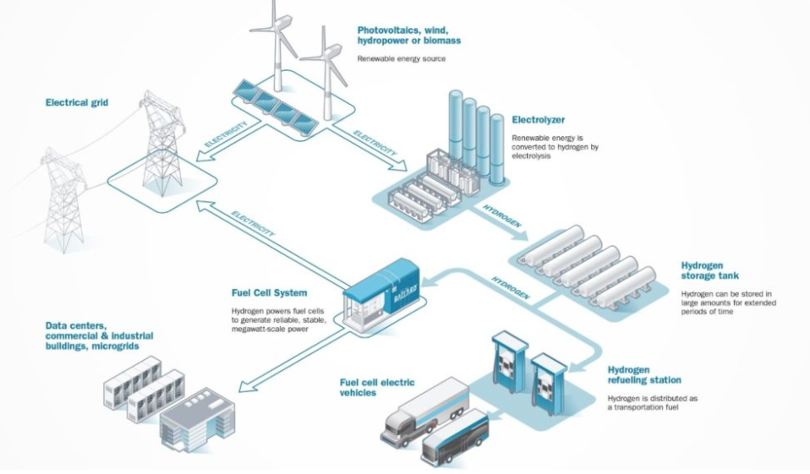
The reliability of energy supply is critical for the safe and efficient functioning of all electrolyser types. Intermittent supply can cause issues with voltage peaks and drops and can lead to electrical damage. This is a particular concern for green hydrogen projects which rely solely on renewable energy sources such as wind and solar, which produce only when the sun conditions allow, or when the wind is blowing.
There are (ever improving) ways to maintain a consistent energy supply on renewables projects i.e. through use of battery storage to store excess power for times of peak demand, but these cannot fully mitigate the intermittency risk, and batteries bring with them their own (i.e. flammability) exposures for insurers.
Insurers and insureds therefore need to closely consider whether business interruption and delay in start-up insurance is intended to cover e.g. lost revenue arising from reduced hydrogen production which prevents an insured from meeting network supply targets/ carbon credit targets.
Physical damage cover
At present, it appears unlikely that market products for green hydrogen cover will also include the renewable power source. There would be inherent challenges in trying to place physical damage cover for these risks together given the requirements specific to each type of technology/project. This may change however where ‘hydrogen hubs’ (areas of co-located producers and users, with concentrated resources, infrastructure and skills in strategic regions) are becoming more popular1.
Contingent DSU / BI
Where the green hydrogen projects and their associated renewable energy sources are insured separately, it is likely that contingent business interruption/ contingent delay in start-up cover will be requested by the insured. This would cover the insured e.g. profit losses where the renewable energy source incurred physical damage and was therefore unable to supply the necessary input for electrolysis.
Mitigation
Should ‘hydrogen hub’ cover for both the electrolyser and renewable power plant become available insurers will need to consider the unique loss mitigation. For example, if an insured is waiting for repairs to the hydrogen plant following a damage event and is able to on-sell the renewable power generation that would otherwise have been used for hydrogen production, any revenue earned may mitigate outage losses.
Insurers are likely to continue including clauses in their project cover (and indeed most common law systems defer to the mitigation principle as a default position) requiring insureds to mitigate loss. Where adequate storage solutions are available to the project, the insured may elect to store the excess generation rather than sell it. The extent to which an insured is able to make this election should be anticipated and dealt with in the project cover.
Existing hydrocarbon infrastructure
The production and transportation of hydrogen using existing gas turbines and natural gas pipeline networks has been proposed as a way to deliver renewable energy to markets whilst preserving the safety and durability of existing networks2. Retrofit solutions are being developed which will enable e.g., gas turbines to burn hydrogen. This repurposing would save significant capital spending and allow for a more time efficient energy transition.
However, blending hydrogen with natural gas beyond a certain volume threshold (c.20%) may require utilities to replace rather than retrofit their pipelines3. This is due to various issues associated with pipeline transmission of hydrogen, including the potential for hydrogen to embrittle the steel and welds used to fabricate the pipelines, and the risk of hydrogen permeation and leaks. Additionally, if hydrogen is incorrectly purged (the removal of air and oxygen from the existing pipeline system) there is a risk of explosion during maintenance or repair operations.
The insurance of hydrogen infrastructure is therefore complex, and care will need to be taken to ensure, particularly with a retrofit, that it is properly understood at an engineering level. Further, if retrofitted equipment and infrastructure is in use on the project, the depreciation potential should be closely considered.
1 See for example the NSW Hydrogen Strategy that was recently implemented by the New South Wales state government in Australia, which enables and encourages the construction of hydrogen production plants near renewable power sources. https://www.energy.nsw.gov.au/sites/default/files/2022-08/2021_10_NSW_HydrogenStrategy.pdf
2 https://www.nrel.gov/docs/fy13osti/51995.pdf p v.

Andrew Milne
Associate Director, Natural Resources
andrew.milne@charlestaylor.com

Kayaneh Mouradian
Lawyer, Clyde & Co

Sophie Shiffman
Legal Director, Energy, Clyde & Co

