

With coal becoming an increasingly dirty word, especially in Australia, harnessing what on paper seems like a limitless supply of renewables brings its own set of unique challenges.
Coal is yesterday’s news…
Historically a somewhat dangerous commodity to mine, particularly underground, coal is very much in the firing line due to its detrimental impact on climate change and health. There is no doubt that coal’s days as a baseload fuel are numbered. The negative issues surrounding coal have become all too evident, particularly in Australia:
Health:
Pollution from Australia’s 22 remaining black and brown coal power stations has been responsible for 800 premature deaths, 14,000 asthma symptoms among children, and 850 cases of low birth weight in newborns each year. (source: https://www.greenpeace.org.au/research/lethal-power-how-coal-is-killing-people-in-australia/)
Ageing Assets:
The Australian electricity system was founded on centralised, carbon-intensive coal-fired generation and about three-quarters of Australia’s coal-fired power stations are now operating beyond their original intended life (~30 years) and while some have had extensive refits (source: Engineers Australia), they are generally inefficient and carbon intensive.
Market forces:
Finally, in Australia, the viability of coal mining is threatened by the political position now being taken by our biggest trading partners. In 2019, Australia exported A$13.7 billion worth of coal to China. This comprised A$9.7 billion in metallurgical coal for steel making and A$4 billion in thermal coal for electricity generation. The latest official Australian data shows these export levels fell dramatically between November 2019 and November 2020. Today China has started rejecting coal imports from Australia, perhaps in response to the Australian government comments concerning origin of the Covid-19 virus!
It should come as no real surprise, therefore, that Australia’s focus on energy generation for the future is set firmly on renewables.
Wind and Solar Projects accelerate
Australia’s Renewable energy mix is currently biased towards mainly onshore wind and solar panel projects, with some minor investments in the odd Concentrated Solar Thermal Energy (CST) project and plans for a single offshore wind farm.
As of 31 December 2019 there were some 101 Wind Farms operational in Australia, with approximately 38 Projects either under construction or planned. Most of these projects are clustered around the Southern Coastline and exposed to the roaring forties.
Wind farms accounted for 35.4% of the total renewable energy generation in 2019, with renewables themselves accounting for 8.5% of the total energy generation in Australia that year.
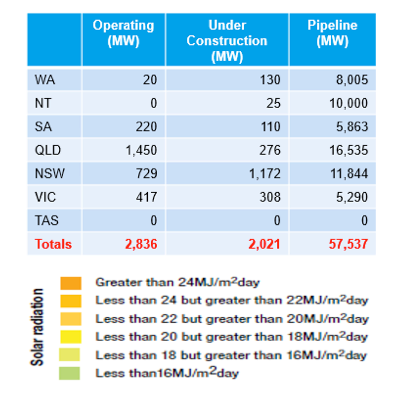
The most dominant form of renewable energy in Australia is solar. This is in part driven by domestic home roof panel uptake, but there are also a substantial number of solar farm projects either built, under construction or planned. The figure on the right provides an indication of the Australian solar project appetite.
Mega Projects for power export
So, whilst the current solar and wind farm prevalence is in the south east coast of Australia, there is an ever-increasing desire to build such projects, particularly solar in northern Australia.
One extreme example of the potential scale being considered in the North, is the 10GW Newcastle Waters cattle station Solar farm, known as the Sun Cable Project.
The $22 billion Sun Cable proposal, involves building a 10GW solar farm with battery storage. Below is an artist’s impression of the Sun Cable Project.
Some of the electricity may be used to help power the Northern Territory capital and Indigenous settlements, but most would be intended for transmission via sub-sea cables that would snake 3,800kms through the Indonesian archipelago to Singapore.
Long-distance high-voltage direct current submarine cables are used in Europe, but this would be the world’s longest by some distance. The project’s goal is to start construction in late 2023 and, to be exporting by 2027. There are similar plans for a sister project in the Pilbara region of Western Australia.
Such projects are in high ‘solar’ areas, but they are also in regions typically frequented by cyclones!
Australian Cyclones
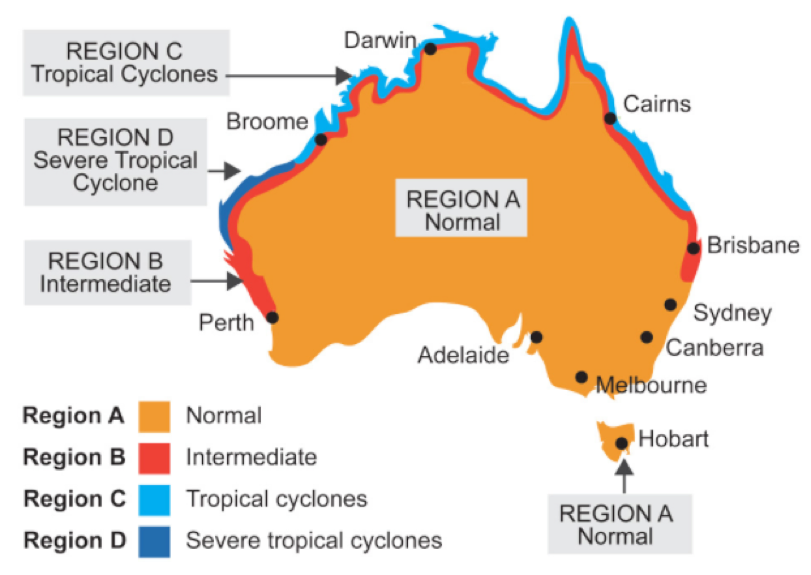
In general terms the northern half of Australia is cyclone prone and building code zones have been established for property established in proximity to the coast. The image right provides some insight as to where cyclones cross landfall and at what intensity.
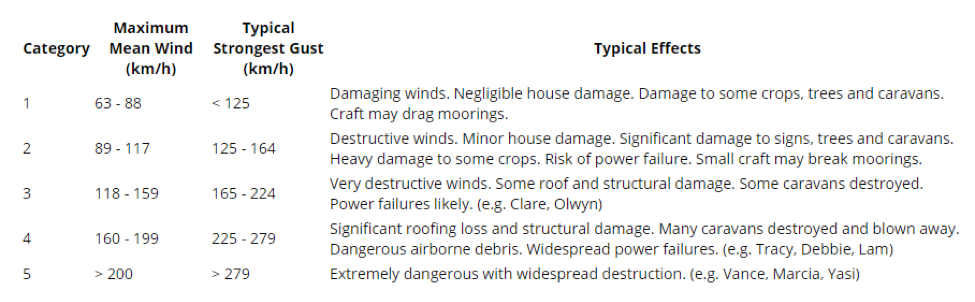
Impacts from cyclones include wind, rain and storm surge, and occasionally they make their way inland with sometimes devastating effect. Tropical lows can also present significant hail damage if the conditions are suitable – this being a particular issue in Queensland and New South Wales. The Australian Bureau of Meteorology categorises cyclones into 5 groups as follows.
Construction & Operational risks
As most renewable projects are not typically adjacent to the sea, storm surge is unlikely. We therefore consider below the main risks of flood, wind and hail damage to both wind and solar projects.
Flood:
Both solar and wind projects could be disrupted by cyclone-related flood waters, regardless of the drainage design. The electrical reticulation of power and control cables when submerged can often be susceptible to electrical earthing and fault. This is particularly possible when flood waters rise over control and junction boxes. Whilst the cables themselves are designed to sit in moist earth, if the terminations are not sound then water ingress is possible.
Water ingress to cables can exacerbate in warm conditions where capillary action can come into play and water is drawn down the cable lengths. In some cases, latent water in energized cables will ‘tree’ through its insulation carcass to earth. Such faults are difficult to find and repair and often result in full cable replacement.
Flood issues typically revolve around water and electrical components coming together. Obviously if the installations are to include large battery banks, then high ground site selection will be essential!
In the construction phase flood can be more devastating as earthworks are often incomplete and subject to wash away. Another issue can also be the early supply of equipment which is then stored in laydown areas at the site ahead of physical construction.
As an aside to the above, one thing that can accompany flood waters in the Northern Territory and Queensland is the unwanted saltwater crocodile, which can be displaced onto sites, and which can then be the cause of some concern for repairers!
Wind:
Cyclonic winds by their very nature exert huge forces on structures. In places such as Fiji for example, the wind farm towers are designed to be lowered ahead of an anticipated cyclone. This is because the blades and towers are not designed to withstand such winds. For the same reason, the size of the wind farms may well be curtailed in Australia as they may not be as economically attractive.
Excessive wind on turbine blades can lead to delamination and there is the additional risk of flying debris impact to the assets. The columns themselves could also be subject to vortex induced vibration due to excessive wind, which may lead to fatigue or catastrophic failure. If the loading is great, then the footings also need to be large and deep.
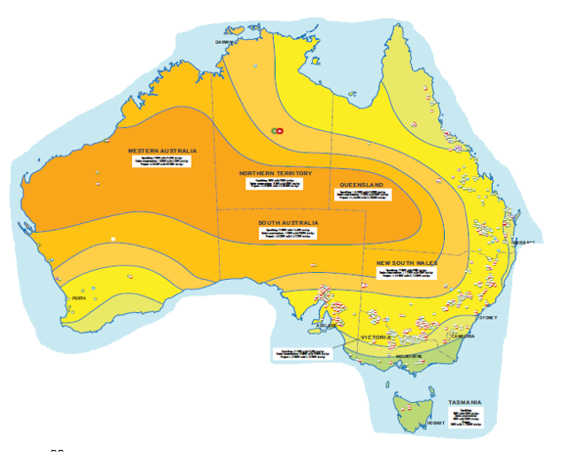
With respect to solar farms, this is a curious situation. The energy output from a solar farm is determined by the surface area of panels exposed to the sun. The structures required to hold these panels in place when faced with cyclonic winds are likely to be large and expensive to produce with engineers likely to focus on the minimum permissible limit in an effort to reduce costs.
The large surface areas of solar panels expose them to a greater risk of surface damage from flying debris. Some solar panel suppliers claim to design their panels for cyclonic winds, but any additional strengthening is unlikely to be able to withstand a flying tree!
Hail:
Hail tends to occur during tropical lows when warm moist air collides with a cold air stream. Such tropical lows, whilst not cyclones, can occur in the tropical regions of Australia.
Both wind turbine blade and solar panel suppliers will design their products to resist hail impact. So, what is the problem?
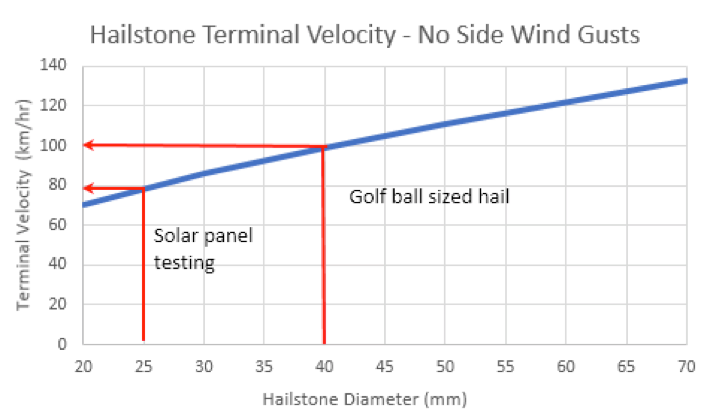
The issue is that the minimum hail stone size upon which these designs are based can often be smaller than some of the intense hailstorms that frequent Australia. Some storms have recorded hail stones in excess of 8cm in diameter; the current solar panel design requirement stipulates hail stones of 2.5cm diameter! Unfortunately, the larger the hail stone diameter the faster the terminal velocity upon impact. So, the damage to assets can be extreme.
Hail can be devastating to both wind and solar farm sites as the damage tends to affect all assets.
Riding the wave
Caution and careful design are required for those brave enough to construct renewable projects in the tropical regions of Australia.
The world is rapidly moving towards greater renewable energy generation. There will, however, always be areas where projects will be cost prohibitive due to either the remote location or the tropical environment involved. Given the issues with coal, the Australian renewable industry will no doubt continue to adapt and evolve to find solutions to these challenges and new projects will be approved and funded.
Unsurprisingly the insurance industry is also riding the wave of both increased interest and investment into renewable projects, the impacts of tropical storms notwithstanding.
Regardless of how the industry evolves, CTA will be ready to assist with claims from both construction and operating assets should they appear in these higher risk areas of the country.

Andrew Hodkinson
Regional Head – Australia & New Zealand, Senior Engineering and Resources Adjuster
andrew.hodkinson@charlestaylor.com
Expertise:
Natural Resources, Power Generation and transmission, Refinery and Chemical Processing (tanks, classifiers, heat exchangers, catalytic converters, absorption towers, piping etc), Heavy Mechanical Equipment, mobile plant, crushing plant and Manufacturing, Infrastructure (pipelines, civils, structures etc), Mining
Location:
Perth

