

Tropical cyclones, also known as hurricanes and typhoons, are the most violent storms on the planet and are common across all tropical waters around the equator. Whilst the Arabian Sea is no stranger to such storms which generally occur in the pre or post monsoon periods, it is not exposed to as many cyclonic events as other seas and oceans such as the Atlantic and Pacific. It seems, however, that this trend may be changing.
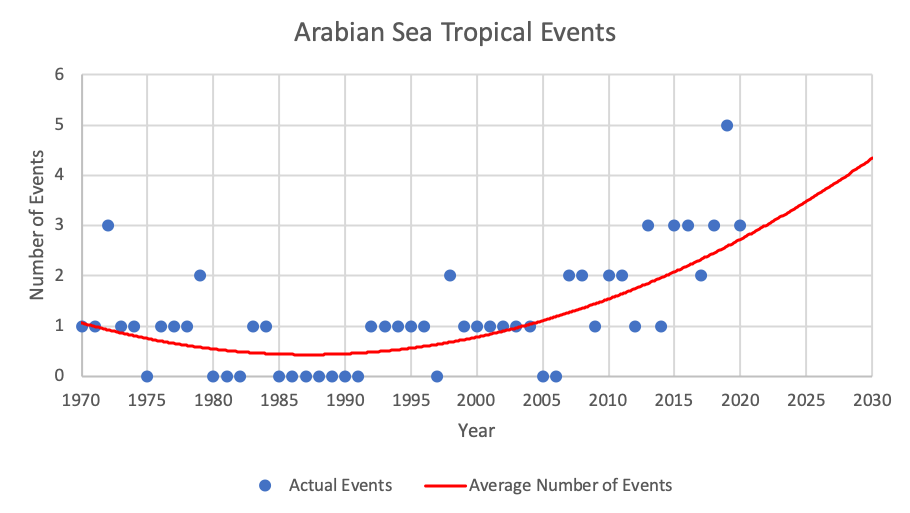
Historic data for the Arabian Sea indicates that at least one weather system would form each year with wind speeds in excess of 50km/h (but which could also reach 222km/h), the highest category according to the India Meteorological Department (IMD), the body responsible for monitoring weather events within the Arabian Sea.
However, reviewing the currently available data indicates that as of 2005, the average number of cyclones is increasing and if the trend continues, there could be as many as of four cyclones per year by 2030 as shown in the graph below.
Record-breaking cyclones
Recent history has seen record-breaking cyclone events for the region in terms of strength, damage, back-to-back occurrences and number of events per year. Since 2007, there have been five events where weaker classified cyclones have caused damage estimated to be in excess of US$1 billion and an additional seven of over US$100 million.
The current theory on the cause of the increasing number of cyclones is the ongoing heating effect of climate change. There are also possible correlations between El Nino Southern Oscillation and Indian Ocean Dipole in the Arabian Sea, although further research is required.
In their Provisional Report for the State of the Global Climate 2020, the World Meteorological Organization reported that 2020 is likely to be one of the three warmest years on record and, as such, it is likely that with more energy stored in the ocean, this will translate into more cyclone events for the region.
Widespread disruption
The violent winds, high levels of precipitation, flooding and storm surges caused by cyclones are not only felt by the countries bordering the Arabian Sea, but can reach countries such as Saudi Arabia, United Arab Emirates, Ethiopia and Djibouti. These effects can cause widespread disruption to operation of hydrocarbon facilities, power and water facilities, airports, ports and terminals and construction sites through physical damage or loss of use.
Whilst the more obvious attention for an Insured relates to having sufficient construction workers, building engineers, materials and supplies available for reinstatement, in the context of an insurance claim it is also essential that loss adjusters have fast and easy access to the Insured assets. During a natural catastrophe, this is often overlooked.
Widespread support
At CTA, we have a wide network of offices and associates around the Arabian Sea that can assist an Insured by helping to establish the scope of damage, directing best reinstatement practices, identifying areas for initial financial support for the Insured and communicating to Insurers their potential exposures.

Anthony Thomas
Senior Loss Adjuster – International Onshore Energy & Mining
anthony.thomas@charlestaylor.com
Expertise:
CAR/EAR, Engineering, Business Interruption, Onshore, Power Generation & Utilities, Plant & Machinery breakdown, Natural Resources
Location:
Dubai

