

The research and development poured into clean energy sources has reduced their cost and increased their output in recent decades. But the international community is still a long way short of being able to switch off its reliance on hydrocarbons.
Indeed, the future success of net zero strategies relies on our ability to transition away from hydrocarbon fuels in a more sustainable way. This means we have to implement processes – at an industrial scale – that support the ongoing use of these fuels and maximise the use of existing assets, but in a clean way that reduces, if not eliminates, any associated carbon dioxide emissions.
In 2022, the global portfolio of carbon capture, transport, storage and utilisation projects that were operational, under construction or planned, had a combined capacity of around 50 mega tonnes of carbon dioxide annually. By 2030, that’s expected to rise to more than 300 mega tonnes. This is still a long way short of current global carbon dioxide emissions, which are around 40 giga tonnes annually.
Carbon capture techniques
Carbon capture technology falls into four main categories:
1. Post-combustion processes in which carbon dioxide is separated from the flue gasses that result from burning fossil fuels.
2. Pre-combustion processes in which a fuel (coal or gas) is reacted with air or oxygen to produce a synthetic, carbon monoxide and hydrogen gas. The carbon monoxide is further reacted with water to produce more hydrogen, and carbon dioxide, which is then captured.
3. Oxyfuel combustion processes burn a fuel in pure oxygen, rather than air, and result in virtually all the waste gas being composed of carbon dioxide, which is captured, and water vapour.
4. Direct air carbon capture techniques recreate what trees do naturally, the technology draws in atmospheric air and extracts the carbon dioxide before returning the residual gas to the environment. It’s one of the more expensive carbon capture technologies because atmospheric carbon dioxide is not as concentrated as it is in a flue gas.
Transportation
Once captured, carbon dioxide needs to be transported for either storage or subsequent use. Carbon dioxide transport via pipeline is well established. However, the large-scale transportation of carbon dioxide by ship is in its infancy, although the logistics are similar to those required to ship liquefied natural gas. One important point is that carbon dioxide is an acid gas, which reacts with water to form carbonic acid. Carbonic acid is very corrosive to carbon steels. Thus, carbon dioxide transported through carbon steel pipelines needs to be dry.
Carbon storage
Once captured and transported, carbon dioxide can be stored in underground reservoirs. In structural storage, it’s injected into an underground reservoir and slowly seeps upwards until it’s stopped by the boundary layer of impermeable rock. This mechanism has kept oil and gas locked underground for millions of years.
Over time, the carbon dioxide trapped in reservoirs will often begin to chemically react with the minerals of the surrounding rock. This is called mineral storage and creates solid, chalky minerals, essentially locking the carbon dioxide into the rock.
With saline aquifers, the carbon dioxide dissolves into the salty water in a process called ‘dissolution storage’. Here, the dissolved carbon dioxide slowly descends to the bottom of the aquifer.
These processes work to store carbon dioxide almost indefinitely, with studies showing retention rates of around 98% being expected after 10,000 years of storage.
How dangerous is CO2?
The air we breathe contains CO2 at a concentration of around 0.04%. Higher concentrations can have the following concerning effects:
>5% - causes disorientation, confusion and seizures.
>10% - causes convulsions, coma, and death.
>30% - loss of consciousness can happen in seconds.
Risks associated with carbon capture and storage
Carbon dioxide has several interesting properties that may seem innocuous, but present significant risks.
- It’s an intoxicant and an asphyxiant. It’s also colourless and odourless, making it difficult to detect.
- Carbon dioxide is around 1.5 times heavier than air, meaning it will settle in low lying areas such as basements or dips in the landscape. Its weight makes it more difficult to disperse than lighter products such as natural gas, and because it’s non-flammable, it can’t be burned off.
- Carbon dioxide can also smother internal combustion engines and impact the effectiveness of other plant and machinery. This is relevant from a risk perspective because it could hamper emergency vehicles and equipment in the event of a large-scale release.
Past releases
In 1986, there was a large-scale release at Lake Nyos in Cameroon, which sits in the crater of a dormant volcano. Over time, carbon dioxide seeps into the lake from the underlying volcano. The gas is held in equilibrium at the bottom of the lake by the pressure of the water above.
The lake suffered a limnic eruption whereby the equilibrium between the water and the carbon dioxide was disturbed. The gas was released and escaped over the rim of the crater, cascading down the side of the mountain into the valleys below. The cloud of carbon dioxide, estimated to be 50m deep, travelled for 25 kilometres and reached speeds of 50km/h. It killed 1,700 people and more than 3,000 livestock.
This was a naturally occurring event and not related to a carbon capture and storage project, but it demonstrates the deadly nature of carbon dioxide gas and the potential risk it presents to human life.
In 2020, there was a major release near a town called Satartia in the US. It was from a 24-inch pipeline used for enhanced oil recovery – a way of injecting carbon dioxide into oil reservoirs to flush out more oil.
The pipeline was built through rugged terrain. Saturated by prolonged rain, the soil around the pipeline slid, causing a pipe weld to break, releasing an explosion of ice and carbon dioxide.
The local area was enveloped with carbon dioxide and panicked residents were left gasping for breath. When they tried to evacuate in their cars, the engines cut out – smothered by the gas.
This incident occurred in a developed country, but there were no provisions, alarms or evacuation procedures. Although there were no fatalities, some residents were left with lasting health conditions. In a less remote location, the outcome would have been a lot worse.
In terms of risk management and mitigation, there are some key areas for the evolving carbon capture and storage sector to consider.
Monitoring for moisture and impurities
Moisture present in the pipeline will combine with the carbon dioxide to form carbonic acid. Impurities can form strong acids such as sulphuric and nitric acid. Both can cause rapid corrosion (<20 days) and potentially lead to ruptures and large-scale releases.
Any machinery or instrumentation breakdown, or design defect could introduce moisture into the pipeline; either resulting in pipeline downtime or a catastrophic failure. The risk of minor commissioning errors introducing moisture and/or impurities is a significant exposure requiring careful attention.
Design codes and regulations
The legislative framework and the specific design codes for carbon capture and storage pipelines vary hugely from one country to another. As these become more consistent and better tailored to the specific requirements of this sector, carbon capture and storage projects will be more able to accurately define their risk profile and mitigate their exposure.
Pipeline routing
Overland pipelines can be buried, creating an additional barrier against release and making it less likely the pipeline will be damaged by a direct collision. Careful routing design will consider the potential for landslides and, where possible, avoid densely populated areas.
While there are plans to use existing pipeline infrastructure from the oil and gas sector, this may bring its own risks as a good design for a gas pipeline could be a bad design for a carbon dioxide pipeline, due to differences in the pressure of these gases and the need to eliminate moisture, to avoid a corrosive environment forming.
Business interruption
The supply chain for carbon capture and storage projects is complicated. It involves the carbon dioxide producer, those transporting the gas and those storing the gas. There are also those using the gas to consider. If there’s a failure in any of these links, this can generate significant business interruption losses for all stakeholders, as detailed in the infographic alongside.
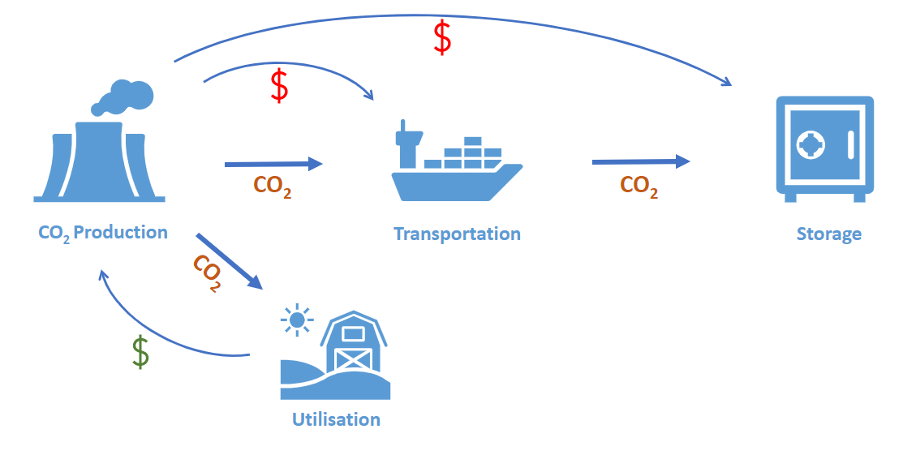
Carbon Capture Supply Chain
Conclusion
The insurance industry is going to see a lot more carbon capture and storage projects seeking cover in the coming years.
While the construction of these projects and the process of retrofitting carbon capture technology to existing energy, industrial and manufacturing plants is well-understood, it carries significant exposures and practical limitations.
Similarly, the transportation of carbon dioxide via pipelines and the subsequent storage processes does not present unworkable risks to the market, but it does have sector-specific risks that need to be addressed.
As the number of these projects increases, the insurance market should be mindful of the nuances that these risks present when compared to others in the energy and construction sectors.
Developing the requisite in-house expertise and working with similarly specialised partners will assist carriers seeking to expand their portfolios in this growing area and ensure they offer the required support to their respective clients.

Louis-Florent Daspre
Senior Adjuster, Natural Resources
louisflorent.daspre@charlestaylor.com

Joe Brennan
Senior Engineering Adjuster, Natural Resources
joe.brennan@charlestaylor.com

