

A major supplier to the power generation industry recently announced that it repeatedly falsified inspection reports for its forged products over a 24-year period.
On May 9, 2022, Japan Steel Works Ltd. (JSW) issued a newsletter on its website admitting to and apologising for nearly a quarter-century of falsifying quality inspection data for forgings sold to Original Equipment Manufacturers (OEMs) in the power generation industry. If products failed to meet required standards during inspections, the company’s product department instructed the inspection department to manipulate the data so that they would pass. JSW also said it had altered or omitted some of the measuring procedures to avoid delays in the delivery of the products. This announcement could impact underwriting and claims handling for power generation clients. This article explores the ways in which this announcement could impact the underwriting and claims handing for power generation clients.
Turbine/Generator Shaft and Generator Retaining Ring Forgings
Certain critical parts used in power generation, such as turbine and generator shafts and generator retaining rings, are typically machined from forgings due to the improved mechanical properties and metallurgical structures the forgings provide.
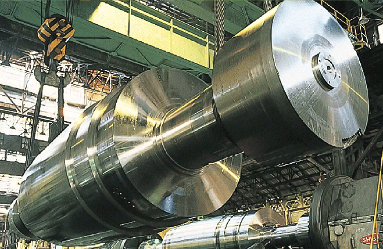
Photo of steam turbine rotor forging from Japan steel works website
When a forging for a turbine shaft or retaining ring is complete, the forge shop will perform ultrasonic and metallurgical tests on the forging to determine whether the forging meets the OEM specifications. It appears, based on the information provided by Japan Steel Works, that the inspection data that was modified included hardness, residual stress readings and gas component analysis of the forgings. If the data does not meet the OEM specifications, the forging should not be shipped, but instead undergo further review and repairs or be scrapped.
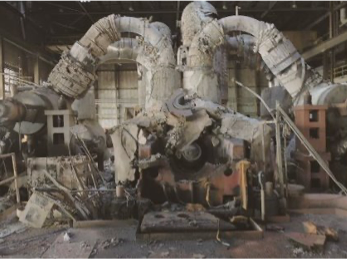
Failure of the forgings to meet the OEM specifications, especially in high temperature and high stress area applications such as the rotor and retaining ring forgings, can cause a reduction in the strength of the material. The compromise in material can shorten the life of the component and make it more susceptible to fatigue failure. A fatigue failure of the forged components in operation can be catastrophic, often resulting in large property damage and time element claims.
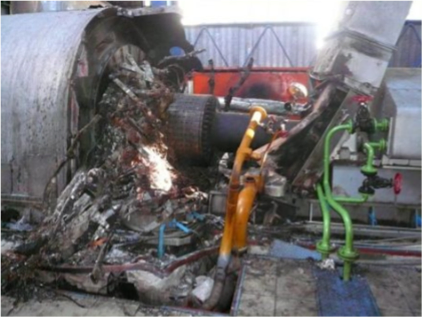
Results of mechanical failure of a retaining ring during operation (photo provided by MGTA Group).
Results of mechanical failure of a steam turbine rotor during operation (photo provided by MGTA Group).
JSW’s Announcement
JSW operates one of the largest production facilities in the world, in Muroran, Hokkaido Japan. This plant is one of only a few facilities capable of forging the world’s largest-sized rotors. Reportedly, a whistleblower initially exposed the falsified data in February of 2022. In April 2022, the Muroran Plant was transferred to a subsidiary of JSW – Japan Steel Works M&E, Inc.
In its May 9, 2022, newsletter, JSW described data falsification in some of the critical inspections that should have been conducted during the manufacturing process at the Muroran Plant as far back as 1998. When a product failed to meet exacting standards during an inspection, the factory’s product department instructed the inspection department to alter the inspection results or change the measuring method so it would pass. The inspection methods that were modified included hardness, residual stress readings and gas component analysis in the forgings.
The data falsification appears to have been born of pressures associated with making on-time product deliveries. JSW admitted that some of the products involved have been shipped for use at power plants, but it has not yet disclosed the names of the facilities, or the number of products affected.
In its announcement, JSW acknowledged that its actions may have violated the contracts with its customers. The announcement went on to say that JSW has not confirmed any specific problems caused by the data falsification which may affect the quality or performance of its products. Also, at the time of the initial announcement, JSW indicated that none of the identified issues involved nuclear power plant customers.
In an effort to mitigate the effects of its inappropriate conduct, JSW established a third-party committee to conduct an investigation. This committee issued a report in November 2022 confirming the data falsification. This report indicated that a total of 449 cases of falsified inspection data had been found, with 20 of those cases related to equipment delivered to nuclear power plants.
A copy of JSW’s May 9, 2022 newsletter can be found here The discovery of inappropriate conduct in quality inspections on some of our subsidiaries' products and establishment of the Special Investigating Committee (jsw.co.jp)
Potential Impact to Property Insurers
During the period in question, JSW provided forgings to power generation OEMs such as Toshiba, Mitsubishi and Siemens. The falsified data, related to turbine shaft and retaining ring forgings, casts doubt that these forgings meet the OEM metallurgical standards. This could result in these components being more susceptible to fatigue failures during operation, especially in high temperature and high stress. This could result in these components being more susceptible to fatigue failures during operation, especially in high temperature and high stress areas, such as those involving the rotor and retaining rings during normal operations. As a result, underwriters of power generation risks may want to investigate and confirm the source of these critical pieces of equipment during their risk evaluation. Moreover, losses involving the failure of turbine shafts and retaining rings will need to be evaluated for possible breach of warranty or potential subrogation.

Fred Popko
Senior Executive General Adjuster,
Natural Resources
fred.popko@charlestaylor.com

