

The production of hydrocarbons in deep and ultradeep water has necessitated the development of Floating Production Units (FPU), and in many cases storage capabilities are also required where Floating Production, Storage and Offloading (FPSO) units are used.
Transportation of hydrocarbons from the seabed to the FPU via a riser system has brought its own engineering challenges. Additionally, transporting fluids off the FPU/FPSO for enhanced oil recovery (water or gas injection) or product export brings similar engineering challenges. The selection of riser concept must consider, inter alia; the hydrostatic pressure, the chemistry of the reservoir fluids, vessel payload, temperatures and pressures of fluids, vessel motions, water depth, weather and sea conditions.
In the relatively benign conditions of say, West of Africa, Steel Catenary Risers (SCR) and Hybrid Riser Towers (HRT) have been widely used. There have been a couple such risers known to have failed during installation.
Flexible risers, in various configurations, have been the design of choice in the moderate conditions of offshore Brazil. The relative ease of installation and their ability to withstand vessel movements has made flexible risers attractive. However, flexible risers come with a relatively high purchase cost and are not without their own limitations. We have experience of many claims stemming from design, fatigue and corrosion problems experienced during operations.
Other available options for riser designs in deep water Brazil include FSHRs and Steel Lazy Wave Risers (SLWR). A FSHR is one with a vertical rigid steel element held in the water column with a buoyancy tank and then a relatively short flexible riser connecting the rigid section to the FPU/FPSO.
So, what’s the preferred riser technology of the day? At the time of writing, at least 10 deep water projects (>2000m) in the pre-salt regions offshore Brazil are being developed with a SLWR riser concept. Based on publicly available information, these projects alone will utilise over 60 SLWR. We are also aware of some projects where operational flexible risers are now being replaced with SLWR due to corrosion issues.
In this article we describe the SLWR and the challenges that these present to the installation contractor.
With a SLWR, the riser may be manufactured from a combination of carbon steel, lined or clad pipe joints. Lined and clad pipe joints incorporate an inner layer of a more corrosion resistant material such as Inconel 625, which is widely used. The exact design will depend on whether the riser is to be used for production, export or gas / water injection. Generally speaking, clad pipe joints will be used in the hot zones, close to the FPU/FPSO hang-off and areas of low bend radius, where stresses are highest. However, clad pipe joints are relatively expensive so are avoided where not required in favour of more cost-effective lining.
The so called ‘Lazy Wave’ shape of a SLWR is achieved by fitting external buoyancy modules (BM) to the outside of the riser. In Brazil, the low lazy wave (where the BM are fitted at the lower end of the riser) is often deployed as it reduces the potential interference with other risers and the FSU mooring system. The water column around a FPSO in Brazil can be very congested due to the high number of risers feeding into the unit.
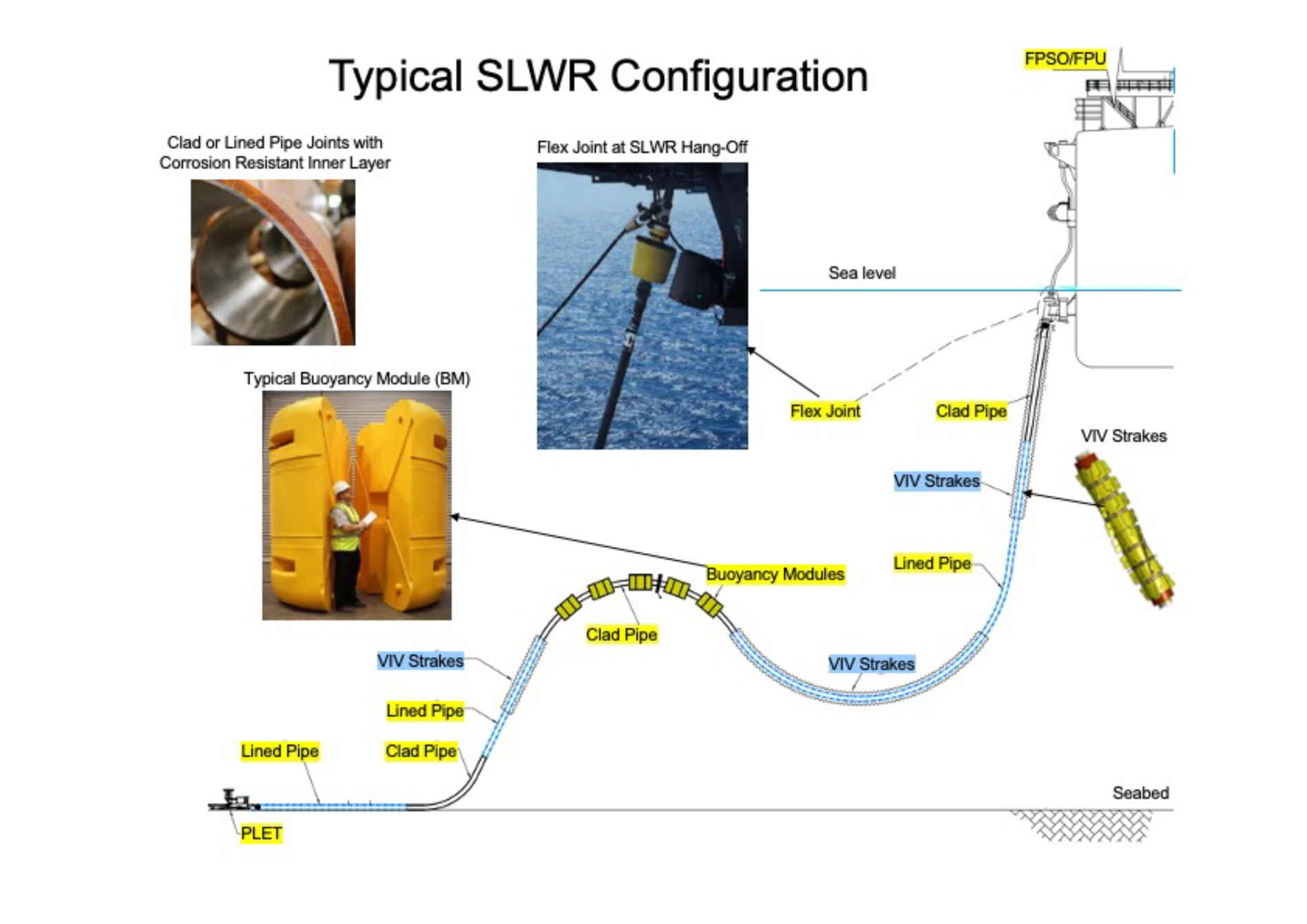
From a risk engineer’s point of view, installation of a SLWR in deep water is very complex and requires meticulous planning. In Brazil, installation is typically planned for the summer months as the critical significant wave height is 1.0m to 3.0m depending on the actual activity being undertaken. As such, timing of the installation is critical, especially when we consider that installation can take as much as 14 days to install, and that once the BMs are being fitted, the process cannot safely be aborted.
It should also be noted that as some of the wells are relatively close to the FPSO the BM installation on deck will start long before the Pipeline End Termination (PLET), being the first piece of infrastructure to be over-boarded, has safely landed on the seabed.
Hence confidence in the weather window is essential to a successful installation campaign.
Due to the complexity of a SLWR installation, any incident which occurs during the process may very well result in a total loss of the riser. It is all the more important that the installation goes exactly to plan and that appropriate risk mitigation measures are implemented.
Should you like to know more about our experiences with historical riser failures or about appropriate risk controls for SLWR installation, please feel free to contact Mike McMahon or Roger Torbergsen.

Roger Torbergsen
rt@agderoffshore.com
+47-90148651
Agder Offshore
www.agderoffshore.com

