
The Republic of Indonesia is an archipelago comprising more than 17,000 islands, with a total land area of 1.9 million square kilometres. Additionally, it includes surrounding sea areas, incorporating an exclusive economic zone, bringing the total area to approximately 7.9 million square kilometres. This vast expanse spans three time zones from East to West.
The oil and gas industry in Indonesia has been active for more than 130 years, dating back to the first oil discovery in North Sumatra in 1885. A member of OPEC from 1961, Indonesia suspended its membership in 2009 due to years of declining production. In 2017, a significant shift occurred in the contract system, which transitioned from the traditional cost-recovery model to the new gross split model. The basic difference between both production sharing contract (PSC) types is how the government and the oil and gas company take their share. In PSC cost recovery, they divide their share from the net revenue, while in the PSC gross split scheme, they directly split the gross revenue.
According to the Indonesian government representative for the Oil and Gas (SKK MIGAS) Annual Report 2022, Indonesia produced 612,300 BOPD and 5,350 MMscfd in 2022. SKK MIGAS has introduced a comprehensive Indonesia oil and gas strategic plan (“IOG 4.0”) with the aim of reaching a production level of one million BOPD and 12,000 MMscfd by 2030.
In 2023, several key upstream oil and gas activities and projects aimed at increasing production had been identified. Among these, four major projects are anticipated to make substantial contributions to production values. These projects have been classified by the government as national strategic projects (PSNs) due to their substantial investment values.
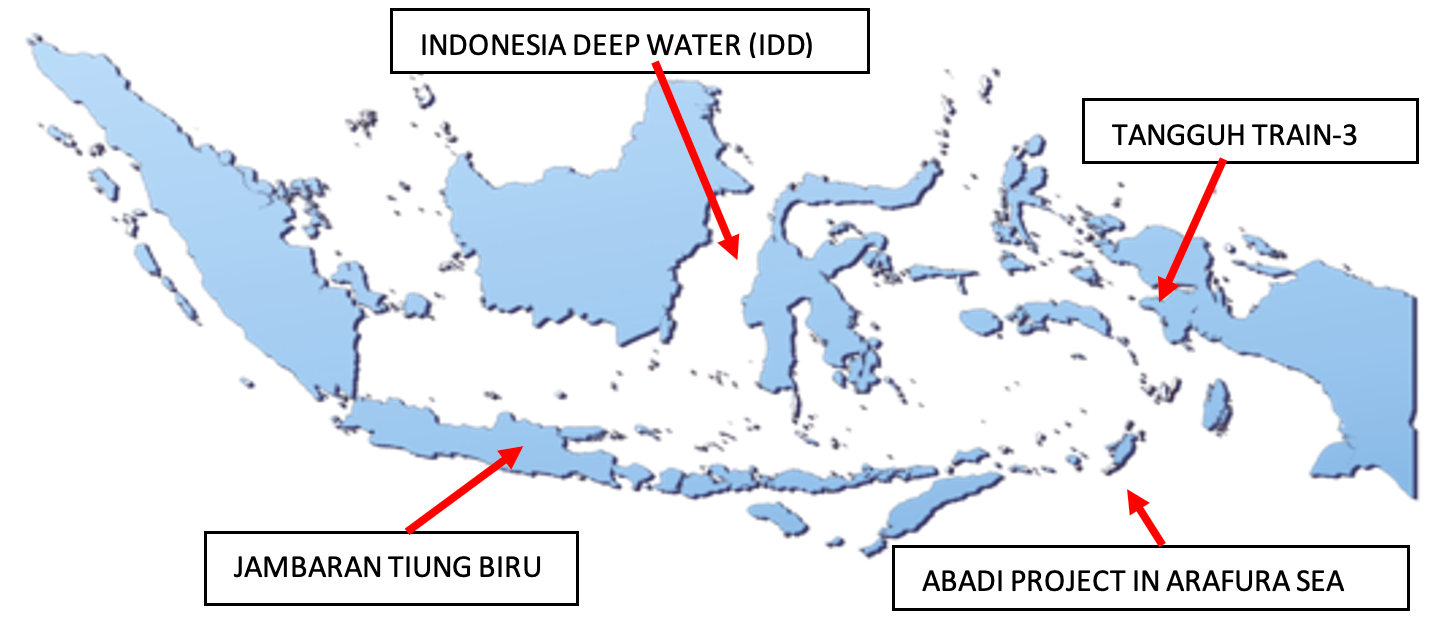
Location of Indonesia oil and gas main projects in 2023.
Jambaran Tiung Biru Project in Bojonegoro, East Java - Investment (Est): US$1.53 billion - (PERTAMINA)
This project encompasses the drilling of 6 gas production wells and 1 temporary plug & abandon (P&A) well. Additionally, it involves the construction of gas processing facilities with a design capacity of 330 MMscfd, as well as the development of supporting facilities such as well pad, access road, production pipelines (18-inch and 20-inch) and sales gas pipelines & metering.
Indonesia Deep Water (IDD) Project in Makassar Strait, East Kalimantan - Investment (Est): US$6.98 billion - (ENI)
An integrated project is underway to develop 5 (five) deep-sea gas fields, ranging from 975m to 1,785m in depth. The primary objective of this initiative is to meet the demands of the domestic gas market and provide support to the Bontang LNG Plant.
Abadi Project in Arafura Sea, Maluku - Investment (Est): US$19.8 billion - (INPEX)
Currently, the project is progressing in the front-end engineering design (FEED) phase for onshore LNG, floating production storage offloading (FPSO), gas export pipeline (GEP), and subsea umbilicals, risers, & flowlines (SURF). These components are in the procurement process, marking a crucial step towards the project’s advancement.
Tangguh Train-3 Project in Bintuni, West Papua - Investment (Est.): US$8.9 billion - (BRITISH PETROLEUM)
The project involves the development of two platform-offshore wellheads named WDA and ROA. Additionally, it includes the drilling of 10 wells and the construction of an LNG train with a capacity of 3.8 million tons per annum (Mtpa). With the incorporation of Train-3, the Tangguh LNG plant is set to operate three trains collectively, achieving a total capacity of 11.4 Mtpa.
In 2022, Indonesia successfully completed 10 of 12 projects located as per the map below. The remaining two projects, namely the YY Project (ongoing) carried out by PHE ONWJ PSC contractor and the MAC Project executed by Husky CNOOC Madura Ltd PSC contractor, have completed offshore platform installation and are currently undergoing the drilling process.
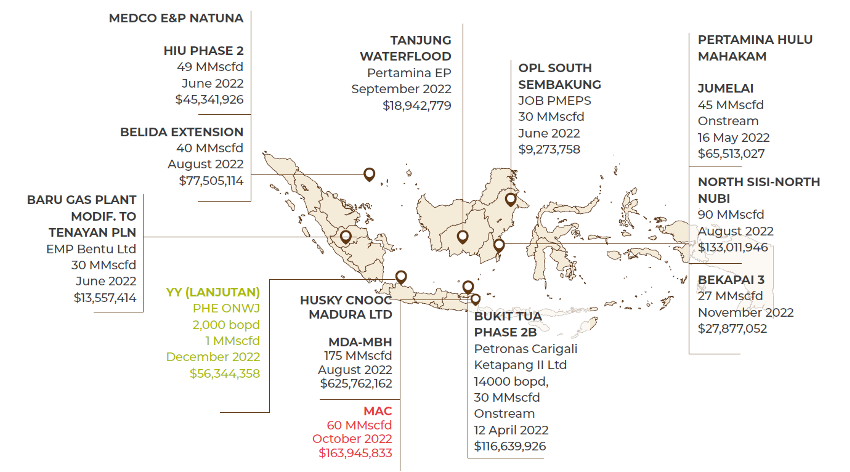
Picture 2, Indonesia oil and gas onstream projects in 2022 (SKK MIGAS Annual Report 2022).
Regarding insurance for upstream energy in Indonesia, the market primarily covers operations/assets and construction projects for both upstream and downstream activities under cost-recovery or gross split arrangements. The PSC contractors that have been awarded the exploration and exploitation of oil and gas blocks are represented by SKK MIGAS, the government representative, as the assured. The consortium of local insurers involved in upstream energy consists of seven companies for asset/operation and eight insurance companies for construction. Both are primarily led by local insurance companies.
A specific agreement for risk placement has been established with the international re-insurance market to cover the potential risks. Placement of risks in the reinsurance market is arranged by re-insurance brokers appointed by the local insurance consortium via a tender process. For downstream losses, there is a retention by the local Indonesian market for a specific amount. However, there is typically little or no retention for upstream risks.
While the Indonesian government has committed to developing a green energy-based industry in the coming years, it appears that fossil fuels, particularly oil and gas-based energy, will continue to dominate until 2040.
In this context, the insurance market for oil and gas continues to play a significant role in the Indonesian
energy markets.

Muhammad Andriansyah
Senior Manager, Natural Resources
muh.andriansyah@charlestaylor.com

