
Energy storage has become a hot topic in the power and renewables industry, but why do we need it?
Energy storage technologies allow us to store electricity for later and discharge it when there is too little generation or too much demand. As our energy supply mix gets greener with low and no-carbon resources, energy storage is crucial to smooth out the delivery of variable/intermittent resources such as wind and solar. Global installed storage capacity is forecast to increase by 56% in the next four years to reach over 270 GW by 2026. The main drivers for this are the need for:
- Greater flexibility in the power market. Energy storage reduces the need to depend on pollution emitting peak power plants.
- Greater reliability in times when the grid is required to respond quickly to disruptions and increases in demand.
- The ability to defer investment in grid reinforcement.
There are many different types of energy storage options available for use in the energy sector and more new technologies are emerging as energy storage becomes a key part of the energy systems of the future worldwide.
This article will focus on batteries as they are the oldest form of electricity storage and are expected to account for the majority of storage growth worldwide. We are all familiar with the Duracell Bunny and anyone who loved science experiments at school will remember making a battery from an orange! However, what battery technologies are we talking about when it comes to grid-scale energy storage?
Battery Energy Storage Systems (BESS)
When developers are choosing the battery technology that works best for them, they want to ensure its affordable, reliable, and efficient. There are three that work for grid-scale energy storage systems:
1. Lithium-ion batteries (Li-ion)
Li-ion account for the vast majority of deployed storage systems in the grid-scale market today.
Over time all lithium batteries degrade, and a replenishment, replacement, and disposal plan are necessary when designing the storage system for a 20-year operating life. Li-ion batteries are solid-state, meaning fewer moving parts.
2. Redox-flow batteries (RFBs)
Like lithium batteries, there are multiple types of flow batteries with a variety of chemistries. Most commercial efforts for grid-scale solutions are using some form of vanadium, iron, bromine, or sodium solution. Although they typically have a higher initial cost relative to other batteries, their lifetime costs may be lower because they don’t degrade.
3. Zinc-hybrid ion batteries
Zinc-hybrid technology is newer. One of the first rechargeable zinc-based batteries came in 1996 and were used to power buses in Singapore. The attractiveness of this type of technology is the cost. Zinc is widely available and typically less expensive than the materials used in Li-ion or flow batteries.
Major Projects around the World
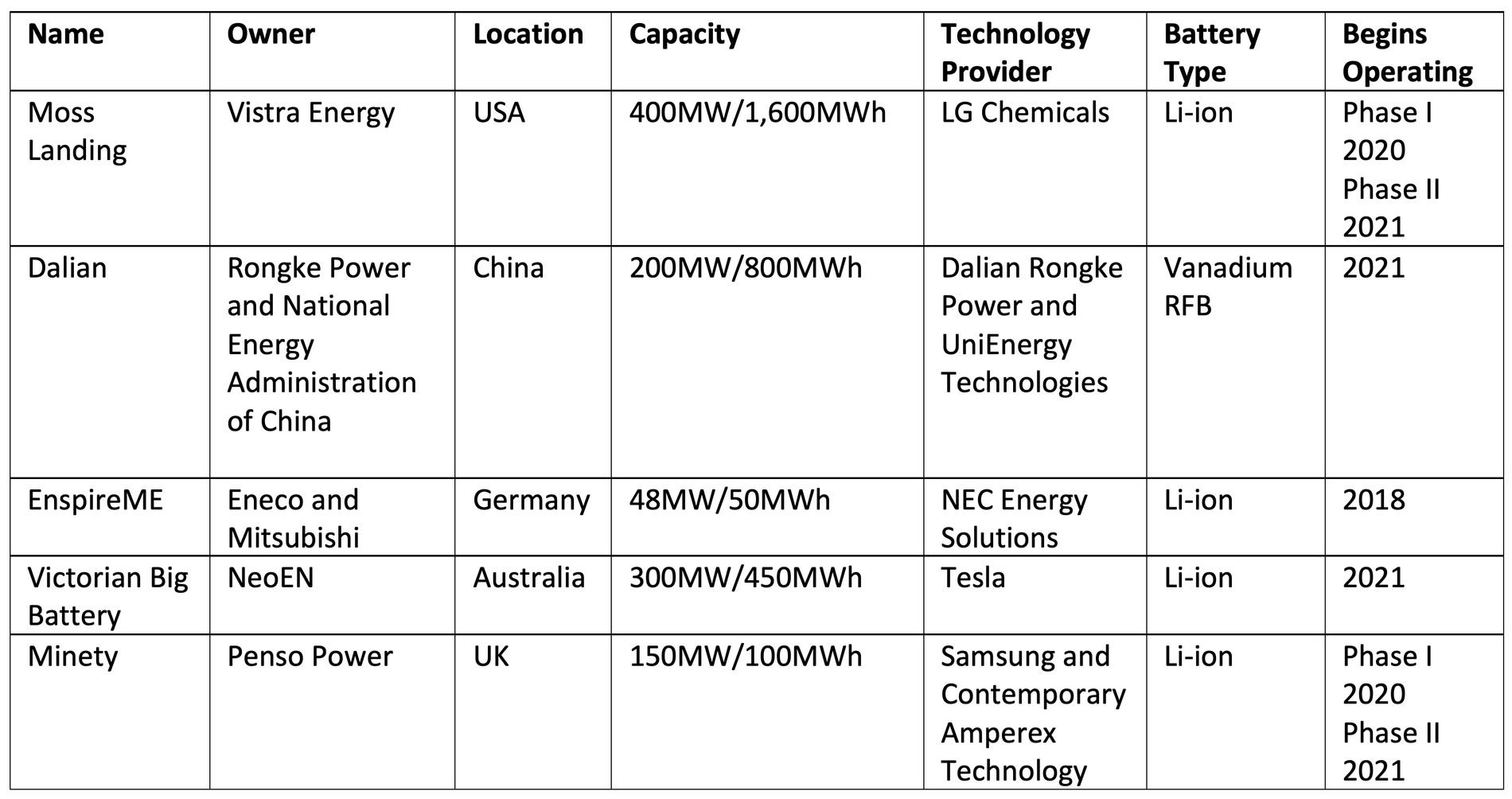
Countries with ambitious climate commitments and supportive policies such as China, the United States, India, Australia, Germany, and Japan are leading the way in implementing BESS. While Tesla, LG Chemicals, RES Group, Powin Energy, Samsung and Nidec are among the top grid-scale technology providers.
Major BESS projects in operation around the world are listed below.
In the past three years, there has been a handful of significant losses at BESS sites around the world. These incidents all involve fires and/or explosions that resulted from batteries overheating and many of these had conflicting RCAs, which questions the industry's understanding of the risks of battery technology. As with any new technology BESS inevitably brings new challenges for the Insurance Market who are on a constant learning curve as these batteries are scaled up in capacity, the technology advances and demand increase at a rapid rate.
Associated Risks
Most incidents at BESS systems have resulted in thermal runaway and fires which are the largest exposure and can be attributed to many causes:
• Degradation
Li-ion batteries are known to degrade over time, sometimes forming small metal deposits called dendrites, which can eventually reach across a cell and cause a short.
• Inherent cell defects
Several recent incidents have pointed the finger at there being a defect in the battery cells. This has not been unique to a particular manufacturer or design, but seems to be a side effect of this developing technology.
• Safety
Regulatory frameworks and codes have been introduced to ensure safety and standards during installation and operation of BESS, but can these keep pace as the technology develops? This equipment is fragile and there have been several incidents where the batteries were damaged during construction.
• Adequate Monitoring and Protection Systems
Early detection of faults is key to preventing or limiting thermal runaway. BESS operators are still learning what temperature control systems, fire suppression systems, cooling, ventilation, and isolation techniques are required.
• Operator Error
As with any industry, training of personnel will be key to operating and maintaining a BESS site effectively. There have been incidents where a BESS was operated outside its recommended parameters which again resulted in a fire.
The lessons the industry has learned from recent events at BESS sites is that batteries are inherently fragile, and any electrical, thermal, or mechanical abuse, along with internal defects, can potentially initiate cell failure and thermal runaway. As we have seen in other areas of the energy industry, standards and best practices will evolve as we learn from past events. This and the build-up of historical loss data will with time bring confidence to the Insurance Market.

Eibhlin Powell
Associate Director – Charles Taylor Adjusting, Natural Resources
eibhlin.powell@charlestaylor.com
EXPERTISE:
Loss Adjuster, Process Engineer, Onshore and Offshore production facilities, Refinery and Petrochemical Operations, Renewable Energy, Construction & Operating Risks, DSU/BI, Natural Resources, Failure Investigation
LOCATION:
London

